
Foundations Check-in: June 2026
Three-month Bitcoin price retrospective, and what we're looking out for this summer.

With the latest Bitcoin price action in mind, we thought it a good opportunity to revisit some of our previous metrics and look ahead into the summer.
TL;DR
Bitcoin is still very cheap vs our long-run model — same story as three months ago.
The big picture still fits, while the short-term read is getting messy.
Expect a rough summer; we’re watching for signs the downward grind is easing, not calling the bottom yet.
June 4, 2026 @ $64,843 (p12):
Bitcoin now sits more than 50% discounted relative to its implied path (~$132,161). Three months have passed since we initially wrote about this price regime (Don’t be surprised this year), and we’re still here!
Daily Drift Diagnostics (2026-06-04)
Exponent: 5.6149 (-0.6210%) - trend below our central anchor.
R²: 0.9440 (+0.0848%) - strengthening above our model baseline.


Our core metrics agree: despite an extended short-term trend below the central power-law attractor, Bitcoin’s scaling relationship remains intact (structural integrity).
Are we any closer to price regime change?
The evidence says yes.
To briefly recap: In Is Bitcoin’s next shock weeks away? we introduced Scaling Shock (Δr²) and Regime Instability Score (RIS) on the 2Y rolling window, as a way to detect periods of extreme fit stress. We took this a step further in Transition Score, where we overlaid RIS with deviation percentile and the absolute 2Y exponent daily drift onto one graph and identified 6 previous times these regime shifts occurred.
Let’s take a look at how those metrics have evolved since February and see an updated version of that chart.
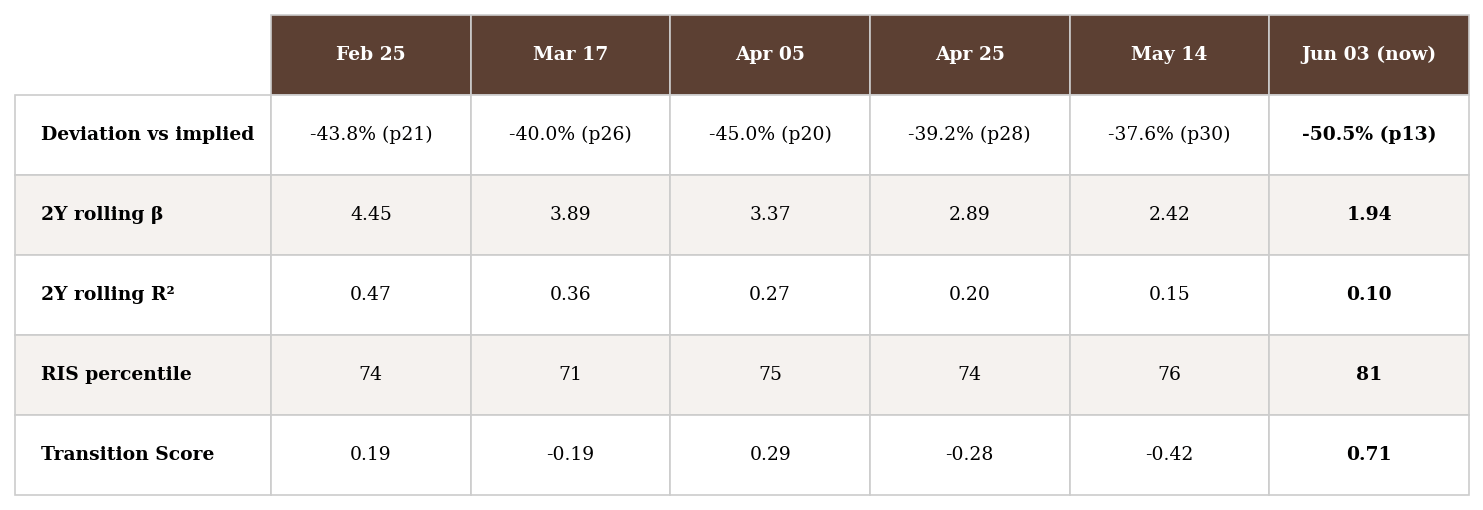
The 2Y rolling exponent and r² are trending down (-50.5%, p13), and our signals for regime transition (RIS ~81, TS ~0.71) are accelerating. We interpret this in two ways:
The last two years of trailing price data has read less and less like a single stable power-law segment.
Given the greater context of our current bear market, this “shock” would signal the earliest signs of a recovery away from this trend. Not that this signal identifies the exact low, but that it has historically appeared near the conditions that precede trend repair.
Ultimately, this does require the conviction that Bitcoin will continue to observe its long-term power law scaling behavior. We can show the cyclical nature of that scaling relationship by recreating the graph from the paid article.
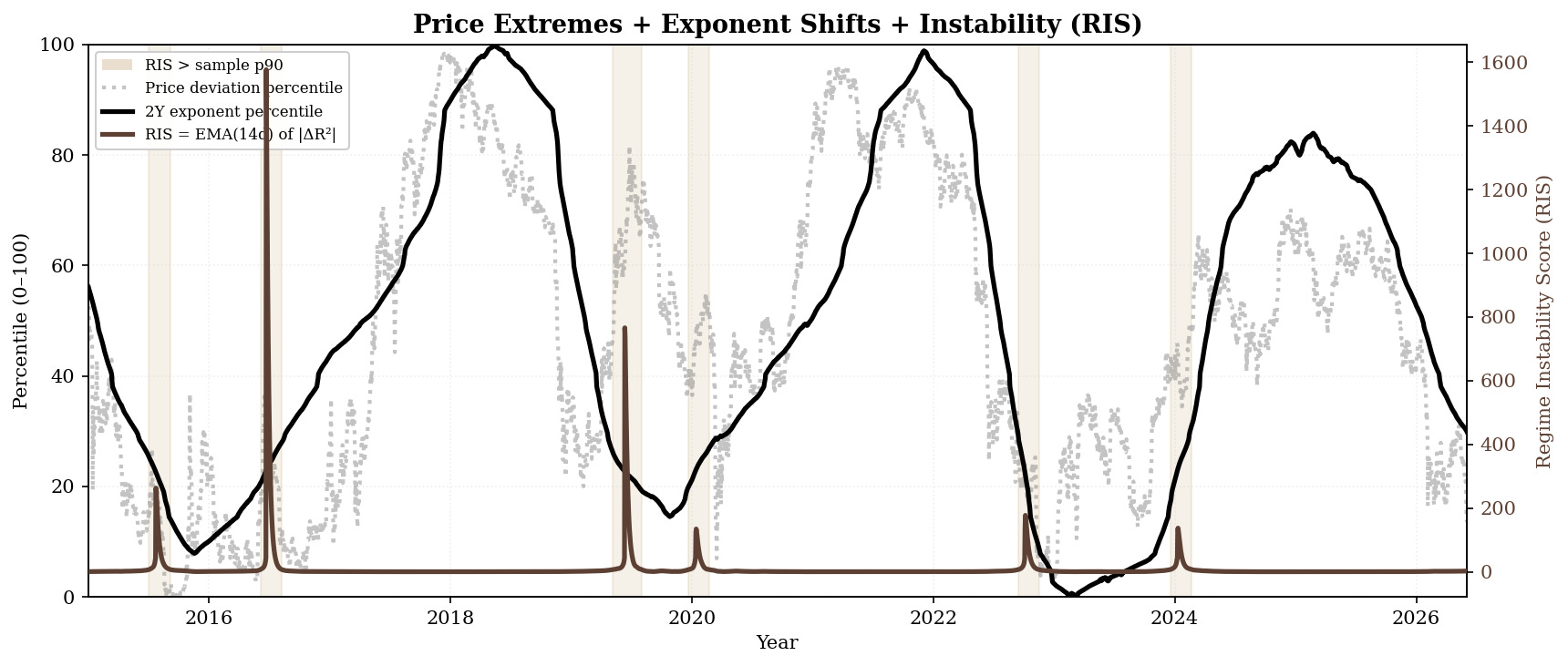
Mirroring previous cycles, we expect to see RIS enter the p90 zone within weeks. Like previous cycles, this will usher in an unbelievable amount of volatility.
Zooming in on RIS — you can see the pressure that’s built since February break out and accelerate away.
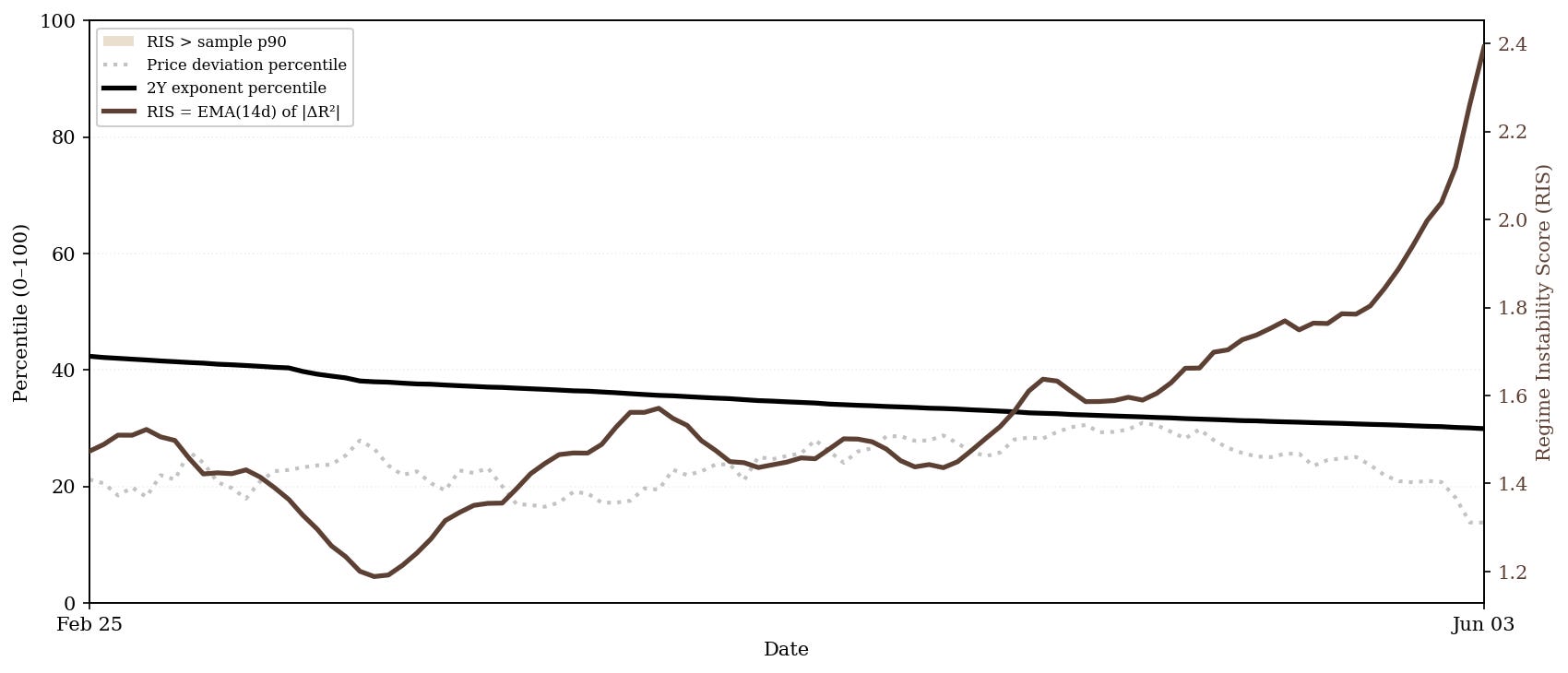
If RIS continues spiking while price deviation deteriorates, then we could be looking at a continued sell-off, potentially extending down to p8–p9 before a reversal this summer.
Who knows if we’ll actually visit those levels, but it wouldn’t be uncommon for Bitcoin at all, as we haven’t visited p10 lows since January 11, 2023 — a level we stayed at for two months.
Revisiting the Rolling 2Y and 4Y curves
In Is regime shift on the way? we showed both rolling curves starting to decelerate. We explained this as a transition in motion, and not a one-day regime flip.
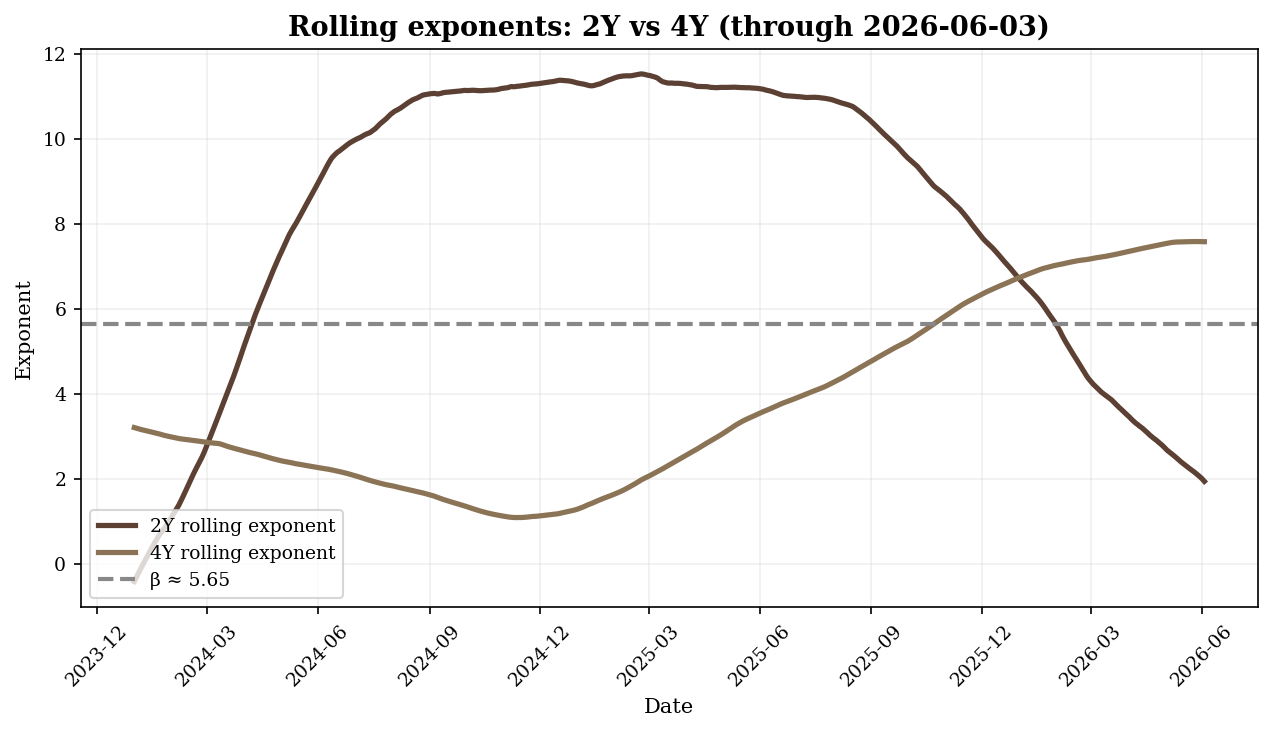
Were we right? Mostly on direction.
The 2Y curve is continuing a deeper descent than we expected, but has slowed its descent since first rolling over in August.
The 4Y has stayed elevated and is only flattening. We eventually expect it to cross below the model baseline at 5.65, but at this time it’s plateaued.
Conviction and Patience
Prioritize the underlying structure. Everything else is noise.
Here’s what we’re watching over the next few weeks:
How long before RIS enters p90?
A signal that the 2Y rolling exponent reverses trend.
Some indication that the 4Y exponent is topping, or finally reversing trend.
Zoom out, way out. Bitcoin remains in a historically deep discount zone, while our local regime metrics are moving toward transition stress. That does not guarantee the low is in. It does suggest the quiet part of this regime may be ending.
Watch the structure and don’t be surprised. Keep on top of our latest research and support our work.
Research infrastructure, not financial advice.